
Travel ·
A Small Escape to Brighton, With Pebbles in My Shoes
From the grand clockwork of London Victoria to the bright, blustery edge of the English Channel, a train ride south delivers sea air, amusement lights and a convincing argument for leaving the city before lunch.
I left London with the modest ambition of seeing the sea before my inbox noticed I was gone.
Brighton is wonderfully obliging on that front. Direct trains run there from London Victoria, London Bridge and St Pancras, which makes the city feel less like a grand expedition and more like London’s slightly eccentric cousin who happens to live beside the water. I chose Victoria: partly for convenience, partly because it is impossible to enter its great Victorian train shed without feeling one ought to be wearing a hat and carrying a leather valise full of correspondence. ([nationalrail.co.uk](https://www.nationalrail.co.uk/discover-by-train/great-british-destinations/visit-brighton-by-train/?utm_source=openai))
London Victoria: The Departure Lounge of Optimism
Victoria on a weekday morning is a living demonstration of purposeful motion. Commuters advance with the solemn concentration of people trying to make a four-minute connection; suitcases clatter; coffee cups are held aloft as if they contain diplomatic documents. Beneath the broad roof, the departure board flickered through its options in that familiar railway manner—inviting, vaguely threatening, and incapable of making platform numbers look relaxing.
The Brighton train was already waiting, long and practical rather than cinematic: a Southern electric multiple unit in green, its doors opening and closing with the crisp authority of a machine that has heard every excuse in the book. Inside, it was a small moving cross-section of southern England. There were students with the look of people who had packed too little, families conducting pastry negotiations, day-trippers in sunglasses despite the clouds, and one gentleman who had somehow brought a bicycle, a backpack and the facial expression of someone personally disappointed by the concept of luggage.
I found a window seat and watched London loosen its tie. First came brick terraces and back gardens, then railway sidings, warehouses and graffitied walls that passed with the confidence of gallery installations. The weather had settled into an entirely British compromise: pale sunlight behind a shawl of cloud, enough brightness to persuade us that a beach day was possible, enough wind to make a coat seem like a morally sound decision.
Southbound: Suburbs, Fields and a Hint of Salt
The pleasure of travelling by train to Brighton is not that the journey is a wilderness epic. It is that the transformation happens quickly. London’s density begins to fray at the edges. Houses gain gardens. Gardens gain sheds. Sheds gain opinions, mostly expressed in fading paint.
Beyond the outer stations, the landscape opens into the gentle folds of Sussex. There are hedges stitched along fields, clumps of trees, occasional horses standing with the impressive stillness of animals that have never once had to answer an email. The track seems to carry you through a series of increasingly green postcards, interrupted by stations that arrive briefly—platform, shelter, a few waiting figures, then gone again.
There is something deeply cheering about the train’s steady electric hum. It is not the romantic chuff of a steam engine, admittedly, but it has its own modern reassurance: a low mechanical conversation beneath the carriage, punctuated by announcements that arrive in a voice so calm it could probably inform you of an incoming meteor without raising its tone.
Approaching the coast, the light changed. It became sharper and flatter, as if someone had wiped the window with a clean cloth. Buildings pressed closer again, but Brighton’s suburbs appeared less interested in uniformity than London’s. Rooflines climbed the slopes; houses seemed to be jostling for the best glimpse of the Channel. Then, suddenly, there was the particular sensation of arriving somewhere seaside: gulls in the air, a wider sky, and people on the platform wearing clothes that suggested both summer and preparedness for betrayal by the elements.
Brighton Station: A Proper Entrance
Brighton’s main station sits uphill from the seafront, a useful fact to remember if you have eaten a large breakfast and are pretending the walk down is merely “a gentle wander.” It is the city’s principal rail arrival point, and its onward connections spread naturally toward the centre, the pier and the wider Brighton and Hove area. ([nationalrail.co.uk](https://www.nationalrail.co.uk/discover-by-train/great-british-destinations/visit-brighton-by-train/?utm_source=openai))
The station itself has the satisfying bustle of a place that knows it is delivering people to a good time. Outside, taxis nosed along the rank, buses came and went, and a parade of visitors spilled downhill with the happy lack of direction that marks the first ten minutes of a day trip. I joined them.
The descent towards the sea is part of Brighton’s trick. You pass cafés, pubs, little shops and streets with a slightly rumpled glamour, as if everyone has agreed that perfection is tiresome but a good lamp, a bright door and an excellent bakery are essential. The town feels theatrical without being precious. It has fringe, sparkle and a healthy appetite for chips.
The First Glimpse of the Sea
Then the streets part and there it is: the Channel, grey-blue beneath a brightening sky, stretching out with magnificent indifference to everybody’s plans.
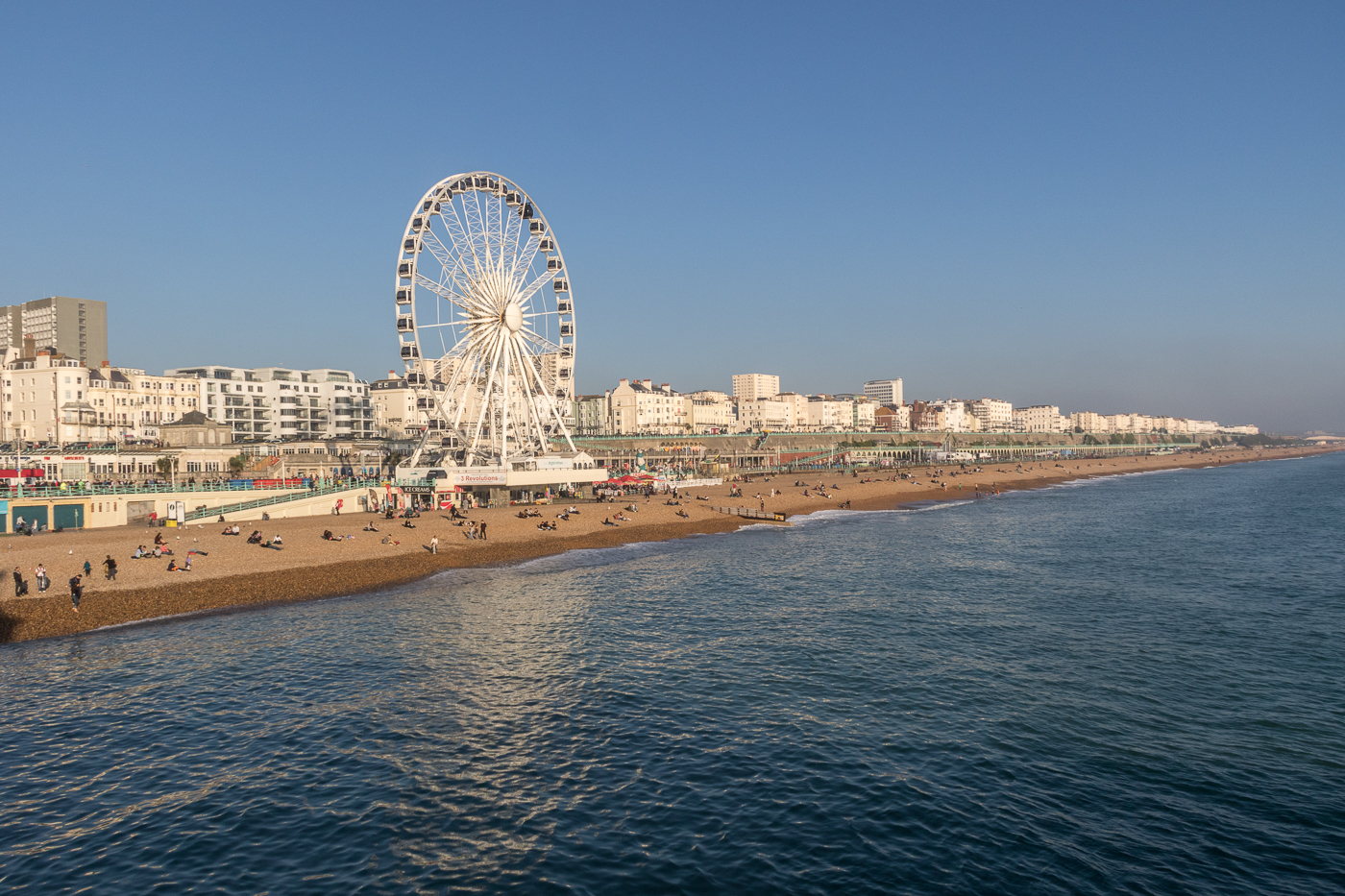
Brighton Beach is not a soft-sand fantasy. It is a pebble beach, which means the shoreline crunches underfoot and sitting down requires either a deckchair, a towel with ambitions, or a spine made from durable materials. But that is part of its character. The stones shine when wet, shifting from chalky white to flint grey and smoky brown. They make the beach feel textured and unmistakably English—less tropical languor, more bracing theatre.
The sea had a tidy chop on it, pushed along by the breeze, and the air smelled of salt, frying batter and sunscreen. People were walking dogs, taking photographs, carrying ice creams with the tense focus of bomb-disposal experts. A few hardy swimmers were in the water, which looked cold enough to improve one’s posture and settle several unresolved emotional issues.
Brighton’s long beachfront has room for different moods: the busy central stretch, quieter spaces farther along, and the steady visual punctuation of the promenade, railings and beach huts. The Palace Pier remains the showiest landmark, its amusements, food stalls and rides extending over the water with the unapologetic cheerfulness of a fairground that has put on a blazer. ([visitbrighton.com](https://www.visitbrighton.com/things-to-do/brighton-palace-pier-p60603?utm_source=openai))
Brighton Palace Pier and the Art of Not Taking Things Too Seriously
I walked out onto the pier as the sun made a more decisive appearance. Below, the sea slapped the supports with a sound like applause from a moderately demanding audience. Above, gulls performed aerial manoeuvres while keeping one eye on anyone holding a bag of chips.
The pier’s arcades have exactly the right level of noise: coins, electronic jingles, bursts of triumphant music, and the occasional shriek from a ride whose passengers had perhaps underestimated both gravity and their breakfast. It is easy to be grandly above all this for about thirty seconds. Then you see the flashing machines, smell hot doughnuts, and remember that dignity has never been a reliable holiday strategy.
What Brighton offers, more than a polished beach escape, is contrast. London gives you speed, scale and the sense that every pavement has an appointment. Brighton gives you wind in your hair, pebbles in your shoes and permission to eat something fried at an hour when you would normally be answering messages. Its seafront is lively rather than serene; its beauty comes with gulls, noise and a strong chance of needing an extra layer.
By late afternoon, I sat facing the water with my coat zipped to the chin and a small collection of Brighton beach stones rattling in my pocket. The sky was clearing in silver-blue strips. The train back would take me north again, toward the city and whatever my inbox had been plotting. But for the moment, London seemed agreeably far away—not another country, exactly, but a place where nobody was currently trying to steal my chips.